Division of Operative Dentistry and Endodontics is a dental division that provides dental treatment

Division of Operative Dentistry and Endodontics is a dental division that provides dental treatment.Dental treatment includes restorative treatment using aesthetic dental materials such as composite resin, endodontic treatment for diseases affecting the dental pulp and periapical periodontal tissue, and subsequent functional restoration treatment.In particular, we provide highly precise, specialized treatment using a dental stereomicroscope (microscope) and handle cases of intractable pain referred from other dental clinics.Furthermore, we collaborate with other related divisions to provide comprehensive treatment.

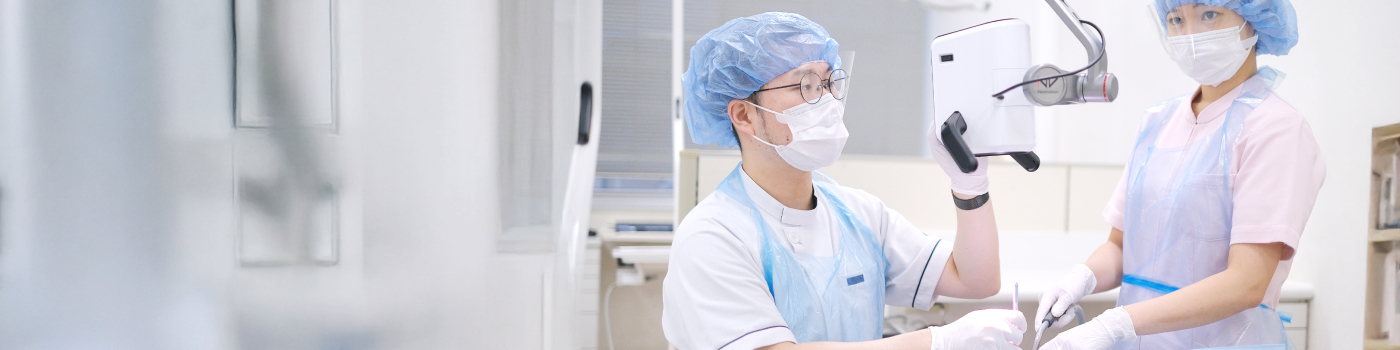
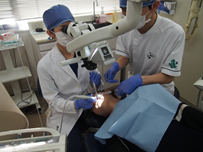
Treatment is performed under a dental microscope.

Target diseases and cases

  • Tooth decay (cavities)
  • Tooth fracture
  • Pulpitis
  • Apical periodontitis
  • Aesthetic disorders

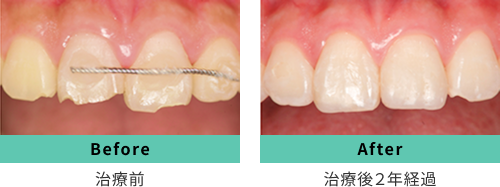
A case of tooth fracture repaired with composite resin.

Before and after photos taken 2 years after treatment.

Characteristics of Examinations, Treatments, and Clinical Cases

Endodontic treatment

For diseases affecting the dental pulp and periapical periodontal tissue, we perform conventional endodontic treatment and surgical endodontic treatments such as apicoectomy under the guidance of a microscope.

conservative and restorative treatment

For dental problems such as tooth decay (cavities) and tooth fractures caused by trauma, we provide aesthetically pleasing treatments using materials such as composite resin.

Medical treatment results 2023

Annual number of patients approx 6,000 First name daily average
approx 25First name

Regarding the private dental services offered in our division

Pulp removal

Treatment Overview

This treatment is used when dental caries (tooth decay) has progressed quite deeply or when inflammation of the dental pulp (nerve of the tooth) has worsened. It involves removing the damaged pulp and the root canal wall (the wall of the root) that has entered with bacteria. This is root canal treatment performed by a specialist in conservative dentistry. During the treatment, the nerve of the tooth is numbed with anesthesia and the damaged nerve is removed. This treatment relieves tooth pain.

Standard cost of treatment

From the start of treatment to root filling for each tooth
1 root canal: Approximately 90,000 yen
2 root canal: Approximately 100,000 yen
3 root canal: Approximately 110,000 yen
(Initial consultation fees, follow-up consultation fees, and examination/diagnosis fees are not included.)

 * There are several stages in the treatment process, from the start to the final treatment, and the cost for each stage is set individually. The doctor will provide details during your consultation.

Risks and side effects related to treatment, etc.

  • While we use advanced equipment such as dental stereomicroscopes and dental cone-beam CT scanners during treatment, there are limitations to the accuracy of diagnosis and treatment.
  • It's not always possible to save the tooth.
  • It may take many treatment sessions for symptoms to improve.
  • The medication used may cause sores if it comes into contact with the gums or mucous membranes.
  • In some cases, teeth may be difficult to save, such as having holes, cracks, or fissures, and in such cases, extraction may be the chosen option.
  • Pain and swelling may occur after treatment due to the body's reaction to the treatment itself.
  • The duration of stable treatment varies from tooth to tooth.
Infected root canal treatment

Treatment Overview

This is a root canal treatment performed by a specialist in conservative dentistry for teeth where the pulp (nerve of the tooth) has deteriorated, or where the pulp has already been removed and there is a lesion in the periapical tissue (bone tissue, etc., at the tip of the root). Each treatment involves cleaning and replacing medication, and after confirming the disappearance of discomfort, the inside of the root canal is sealed with dental material. This treatment removes bacteria, infectious materials, tooth pain, and gum swelling that have entered the tooth root.

Standard cost of treatment

From the start of treatment to root filling for each tooth
1 root canal: Approximately 110,000 yen
2 root canal: Approximately 120,000 yen
3 root canal: Approximately 130,000 yen
(Initial consultation fees, follow-up consultation fees, and examination/diagnosis fees are not included.)

 * There are several stages in the treatment process, from the start to the final treatment, and the cost for each stage is set individually. The doctor will provide details during your consultation.

Risks and side effects related to treatment, etc.

  • While we use advanced equipment such as dental stereomicroscopes and dental cone-beam CT scanners during treatment, there are limitations to the accuracy of diagnosis and treatment.
  • It's not always possible to save the tooth.
  • It may take many treatment sessions for symptoms to improve.
  • The medication used may cause sores if it comes into contact with the gums or mucous membranes.
  • In some cases, teeth are difficult to save, such as having holes, cracks, or fractures, and in such cases, extraction may be the chosen option.
  • Pain and swelling may occur after treatment due to the body's reaction to the treatment itself.
  • The duration of stable treatment varies from tooth to tooth.
Apicoectomy and retrograde root canal filling

Treatment Overview

This is a minor surgical procedure performed when infected root canal treatment (see item 2, section on infected root canal treatment) is ineffective or when infected root canal treatment is impossible for various reasons. It is one of the root canal treatments performed by a specialist in conservative dentistry. The gums are incised, a small hole is drilled into the bone, and the lesion (disease) near the tip of the tooth root and its surroundings is removed. Then, a small hole is drilled into the cut surface of the tooth root and sealed with dental material. This treatment preserves the tooth without extraction.

The procedure is typically performed on the front teeth and premolars, but rarely on the molars. Furthermore, it cannot be performed if the maxillary sinus (the area next to the nose where mucus accumulates) or a large nerve is located around the tooth root.

Standard cost of treatment

Approximately 60,000 yen per tooth
(Initial consultation fees, follow-up consultation fees, and examination/diagnosis fees are not included.)

Risks and side effects related to treatment, etc.

  • While we use advanced equipment such as dental stereomicroscopes and dental cone-beam CT scanners during treatment, there are limitations to the precision of the treatment.
  • It's not always possible to save the tooth.
  • Essentially, this procedure is an additional treatment for cases that do not heal with root canal treatment alone. Therefore, if this surgery is performed without prior root canal treatment, the likelihood of recurrence increases.
  • After the surgery, you will be prescribed antibiotics (to prevent infection) and anti-inflammatory painkillers to reduce infection, swelling, and pain. However, you may still experience pain, swelling, bruising, or numbness in your gums, lips, or cheeks for several days.
  • Incision scars may remain on the gums. Also, the gums may recede slightly.
  • In cases of large lesions, bone may not form completely.
  • Because the tooth root is shortened by the surgery, there is a possibility that the risk of tooth mobility will increase in the long term.
  • There is a possibility of recurrence after surgery. In that case, a second surgery or tooth extraction may be considered.
Removal of foreign objects from the root canal.

Treatment Overview

During endodontic treatment (root canal treatment), a treatment instrument may accidentally break and remain inside the root. As long as the instrument remains inside the root, it will not cause disease. However, if the root canal becomes infected and requires infected root canal treatment (see item 2, section on infected root canal treatment), the remaining instrument fragment will interfere with the treatment and must be removed. The procedure to remove this instrument fragment is called root canal foreign body removal. It is one of the root canal treatments performed by a specialist in conservative dentistry.

The procedure involves identifying the instrument piece using a dental stereomicroscope and performing the procedure using an ultrasonic vibration device. Furthermore, the position of the instrument piece is determined through a preliminary examination using dental cone-beam CT.

Standard cost of treatment

Approximately 50,000 per root canalYen
(Initial consultation fees, follow-up consultation fees, and examination/diagnosis fees are not included.)

Risks and side effects related to treatment, etc.

  • Often, it's necessary to shave down the wall surrounding the instrument piece on the tooth root, which thins the root. In some cases, a hole may even be created in the root wall. These factors can weaken the tooth.
  • It is not possible to remove all instrument fragments. Considering the risks mentioned above, there may be cases where it is better not to remove them.
  • Even if the instrument fragment is removed, this does not necessarily mean that the root canal treatment will be successful.
Sealing of perforated area

Treatment Overview

This treatment involves sealing perforations (holes in the tooth) with dental materials when tooth decay has progressed quite deeply or when the tooth has become thin due to previous treatments. It is one of the root canal treatments performed by a specialist in conservative dentistry. During the treatment, a portion of the diseased tissue is removed with a laser, the area is cleaned with medication, and then the perforated area is sealed with a highly biocompatible dental material.

Standard cost of treatment

Approximately 15,000 yen per tooth
(Initial consultation fees, follow-up consultation fees, and examination/diagnosis fees are not included.)

Risks and side effects related to treatment, etc.

  • While we use advanced equipment such as dental stereomicroscopes and dental cone-beam CT scanners during treatment, there are limitations to the accuracy of diagnosis and treatment.
  • It's not always possible to save the tooth.
  • You may still experience discomfort after treatment.
  • The medication used may cause sores if it comes into contact with the gums or mucous membranes.
  • In some cases, teeth may be difficult to save, such as having holes, cracks, or fissures, and in such cases, extraction may be the chosen option.
  • Pain and swelling may occur after treatment due to the body's reaction to the treatment itself.
  • The duration of stable treatment varies from tooth to tooth.
Hybrid ceramic resin restoration (direct method)

Treatment Overview

This treatment uses a composite material called composite resin, which is tooth-colored, to recreate the shape and restore the function of teeth lost due to cavities or trauma. Multiple composite resins with different shades are used to recreate the tooth color as closely as possible. Since the composite resin is directly bonded to the tooth, the amount of tooth structure removed is minimal compared to metal restorations.

Excluding adjacent tooth surfaces: Approximately 25,000 yen

Including adjacent tooth surfaces: Approximately 30,000 yen

Standard cost of treatment

Excluding adjacent tooth surfaces: Approximately 25,000 yen
Including adjacent tooth surfaces: Approximately 30,000 yen

Risks and side effects related to treatment, etc.

  • If tooth decay or trauma reaches the nerve of the tooth during treatment, the pulp (nerve of the tooth) must be removed.
  • Pain may occur after treatment, and in such cases, it may be necessary to remove the dental pulp.
  • After treatment, depending on how much of the tooth remains after the decay is removed and the bite, some or all of the material may chip or come loose.
  • This material will inevitably shrink when it hardens in the mouth. Therefore, the color at the boundary between the tooth and the material may become more noticeable over time.
  • Over time, the material will gradually deteriorate in the mouth. This deterioration may lead to discoloration of the material.
  • Depending on the degree of tooth discoloration, the resulting color may not be exactly as desired.
Non-vital tooth bleaching (WBT: Walking Bleach Technique)

Treatment Overview

This is a type of teeth whitening treatment for discolored teeth, specifically for teeth without pulp (nerve). Root canal treatment may be performed beforehand if necessary. A whitening agent is placed inside the tooth and then sealed. The agent inside the tooth is then replaced approximately once a week, and this process is repeated until the desired shade is achieved.

Standard cost of treatment

For each tooth, from the first to the third visit: approximately 15,000 yen
For each tooth, from the 4th visit onwards (additional medication fee): Approximately 3,500 yen per visit

Risks and side effects related to treatment, etc.

  • The effectiveness of bleaching varies from person to person depending on factors such as the degree of tooth discoloration and age. It is possible that the desired shade may not be achieved.
  • While the medication is inside the tooth, a temporary seal is placed over the cavity. If this seal comes off, it could potentially cause injury to the gums or mucous membrane.
  • Bleaching agents can penetrate the dentin of the tooth and cause the tooth root to be absorbed.
  • The bleaching effect weakens teeth against impact, increasing the risk of them cracking.
  • Even after bleaching, the color may revert to its original shade over time.

Doctor introduction

Head/Professor of Division of Operative Dentistry and Endodontics

Chiaki Kitamura Chiaki Kitamura

Specialty Conservative restorative treatment, endodontic treatment

Certification

  • Certified Conservative Dentistry Specialist (Instructor) by the Japan Board of Dental Specialists
  • Instructor for dental trainees

Bachelor of Science

  • Doctor of Dental Science

Associate professor

Ayako Washio Ayako Washio

Specialty Conservative restorative treatment, endodontic treatment

Certification

  • Certified Conservative Dentistry Specialist (Instructor) by the Japan Board of Dental Specialists
  • Instructor for dental trainees

Bachelor of Science

  • Doctor of Dental Science

Assistant professor

Kazumasa Murata Kazumasa Murata

Specialty Conservative restorative treatment, endodontic treatment

Certification

  • Certified Conservative Dentistry Specialist by the Japanese Society of Conservative Dentistry
  • Instructor for dental trainees

Bachelor of Science

  • Doctor of Dental Science

Assistant professor

Naoyuki Mitarai Naoyuki Mitarai

Specialty Conservative restorative treatment, endodontic treatment

Bachelor of Science

  • Doctor of Dental Science

Assistant professor

Rikako Takami Rikako Nagami

Specialty Conservative restorative treatment, endodontic treatment

Bachelor of Science

  • Doctor of Dental Science

medical staff

Miki Suematsu Miki Suematsu

Specialty Conservative restorative treatment, endodontic treatment

Certification

  • Certified Senior Conservative Dentistry Specialist by the Japanese Society of Conservative Dentistry
  • Instructor for dental trainees

Bachelor of Science

  • Bachelor of Dentistry

graduate student

Tomohiro Takahashi Tomohiro Takahashi

Specialty Conservative restorative treatment, endodontic treatment

Bachelor of Science

  • Bachelor of Dentistry

graduate student

Kyoka Kanaoka Kyoka Kanaoka

Specialty Conservative restorative treatment, endodontic treatment

Bachelor of Science

  • Bachelor of Dentistry

graduate student

Mika Yutani Mika Yutani

Specialty Conservative restorative treatment, endodontic treatment

Bachelor of Science

  • Bachelor of Dentistry

Registered Resident Physician

Hiroki Miura Hiroki Miura

Specialty Restorative dentistry, endodontic treatment, periodontal treatment, general dentistry

Certification

  • Certified Conservative Dentistry Specialist by the Japanese Society of Conservative Dentistry

Bachelor of Science

  • Doctor of Dental Science

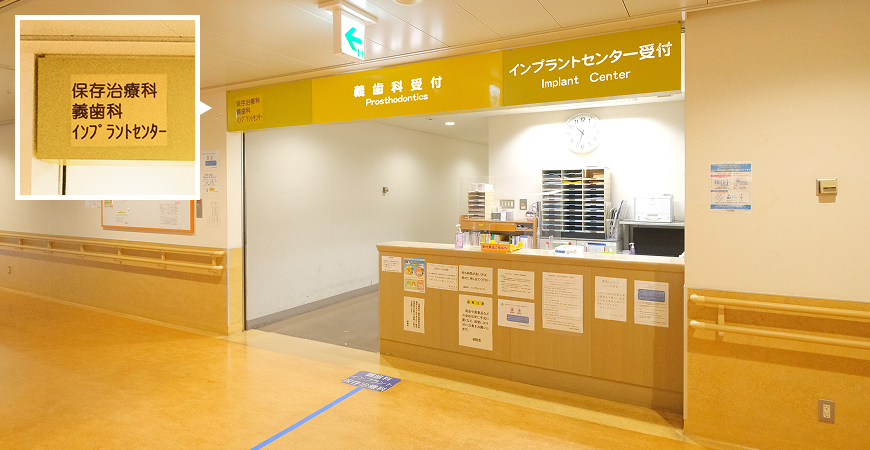
Photo of the reception area at the 5th Division of Operative Dentistry and Endodontics, Kyushu Dental University Hospital.
Division of Operative Dentistry and Endodontics Reception