Mechanism by which RNA chemical modification controls hair regrowth has been elucidated: RNA stabilization by METTL1 regulates hair follicle growth.
September 29, 2026
Kyushu Dental University (Public University Corporation)
Professor Shoichiro Furukabu and Associate Professor Takuma Matsubara of the Division of Biochemistry at Kyushu Dental University (Campus: Kitakyushu City, Fukuoka Prefecture, President: Awano Shuji) have participated in an international collaborative research project with Professor Quan Yuan and others at the West China Hospital of Stomatology, Sichuan University, China.
In this study, we revealed that METTL1 (*1), which has previously been known primarily as an enzyme that modifies RNA involved in the process of protein synthesis, controls hair follicle formation and the hair cycle by modifying and stabilizing the RNA of genes involved in hair formation.
This research reveals a novel mechanism by which hair growth and shedding are regulated by chemical modification of RNA, which may lead to a better understanding of conditions such as alopecia and the development of new treatments. The results of this research were published in the international academic journal PLOS Genetics on September 22, 2026.
[Key points of this research presentation]
- Mice lacking METTL1 exhibit abnormalities in hair follicle formation (*2), resulting in delayed hair regeneration.
- METTL1 stabilizes the RNA of HOXC13 (*3), which is involved in hair formation, by m⁷G modification (*4).
- METTL1 deficiency leads to decreased expression of HOXC13, FOXN1, and DSG4 (*5), resulting in weakened adhesion between hair-forming cells.
- Increasing METTL1 expression accelerates the transition of hair follicles to the growth phase, promoting hair regeneration.
[About the Division of Biochemistry at Kyushu Dental University]
Founded in 1952, the organization restarted under its current structure in 2017. It is dedicated to unraveling the mechanisms by which cells, the smallest units of life, perform various biological functions.
[Research background]
Hair doesn't grow indefinitely once it's formed; instead, hair follicles go through a "hair cycle" consisting of growth, regression, and resting phases, continuously regenerating and replacing hair. For this hair cycle to proceed normally, the cells that make up the hair follicle must proliferate and differentiate appropriately, and then connect with each other to form hair. However, many aspects of the molecular mechanisms that regulate the formation of hair follicles and the hair cycle remain unclear.
In recent years, "RNA modification," the process by which various chemical modifications are added to RNA within cells, has attracted attention as a mechanism that regulates RNA stability and protein production. METTL1 is an enzyme that adds m⁷G modifications to RNA, and until now, it was known to mainly modify transfer RNA (tRNA) (*6), which is involved in protein synthesis. However, in recent years, it has been shown that METTL1 also adds m⁷G modifications to messenger RNA (mRNA) (*7), and that it may regulate its function. However, it has not been clear how RNA modification by METTL1 controls hair follicle formation and the hair cycle.
[Research content and results]
An international collaborative research group, including Professor Shoichiro Furukabu and Associate Professor Takuma Matsubara of the Division of Biochemistry at Kyushu Dental University, investigated the role of the RNA modification enzyme METTL1 in hair follicle formation and the hair cycle.
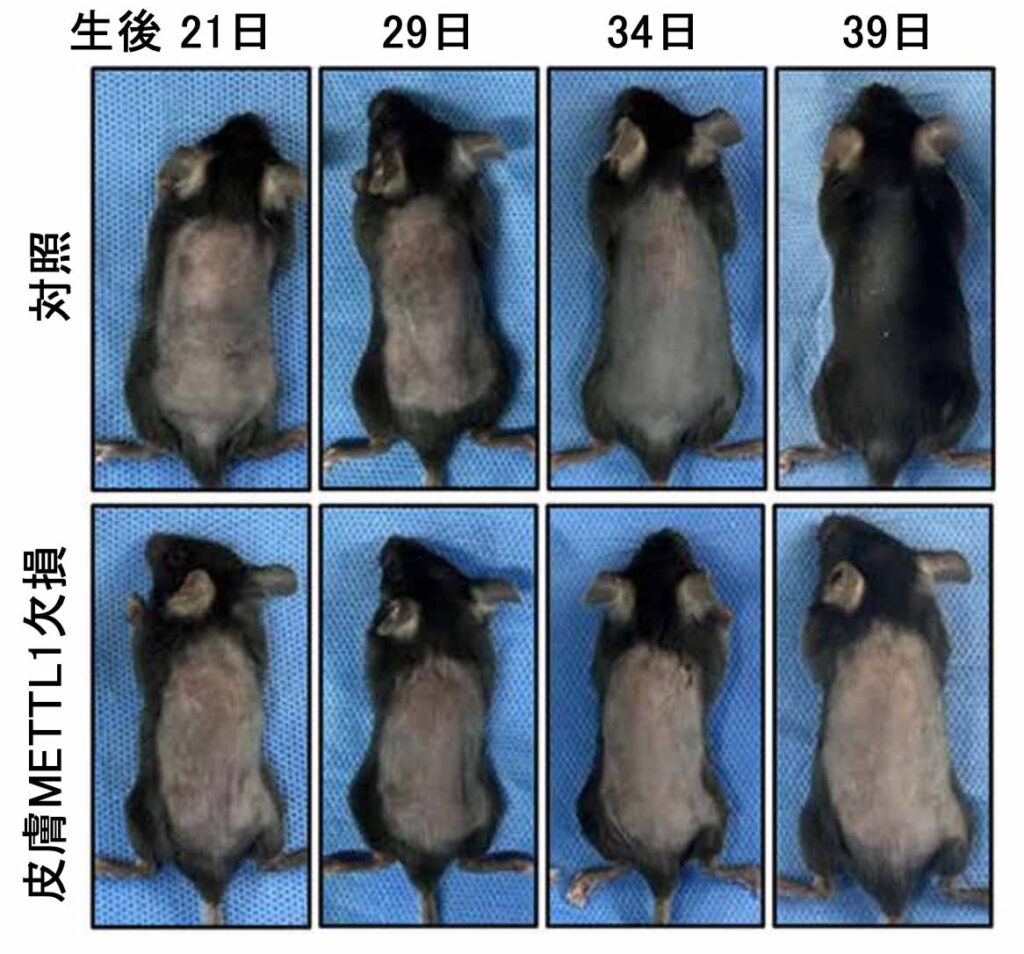
First, we eliminated METTL1 in the skin of mature mice and observed hair regrowth. As a result, we found that hair regeneration occurred in normal mice, while hair regeneration was significantly delayed in mice lacking METTL1 (Figure). Further investigation revealed that hair follicles lacking METTL1 had a delayed transition to the "anagen phase" in which hair grows. From this, we concluded that METTL1 plays a role in the normal progression of the hair cycle.
Next, we investigated the mechanism and found that METTL1 deficiency reduces the function of HOXC13, which is involved in hair formation. Furthermore, METTL1 stabilizes HOXC13 mRNA by adding m⁷G modifications to it. When METTL1 is absent, HOXC13 mRNA becomes unstable, and the downstream functions of FOXN1 and DSG4 also decrease. As a result, it is thought that the adhesion between hair-forming cells weakens, hindering normal hair formation.
These results reveal that METTL1 controls hair follicle formation and the hair cycle by stabilizing HOXC13 mRNA through m⁷G modification, thereby maintaining the function of downstream FOXN1 and DSG4. This study demonstrates a novel mechanism by which chemical modification of RNA regulates hair formation and shedding. (Figure: Hair regeneration is delayed in mice lacking METTL1 in the skin. Hair regeneration progresses in normal mice (top panel), while it is delayed in METTL1-deficient mice (bottom panel).)
<Figure>
[Future Developments]
In the future, we will clarify how this mechanism is involved in human hair follicles and alopecia, and further research the relationship between RNA modification and hair formation and regeneration. We will also investigate the possibility of regulating the hair cycle by controlling RNA modification by METTL1 and the molecules that act downstream of it, aiming to develop new treatments for alopecia and other related conditions.
<Comment from Professor Shoichiro Furukabu of the Division of Biochemistry>
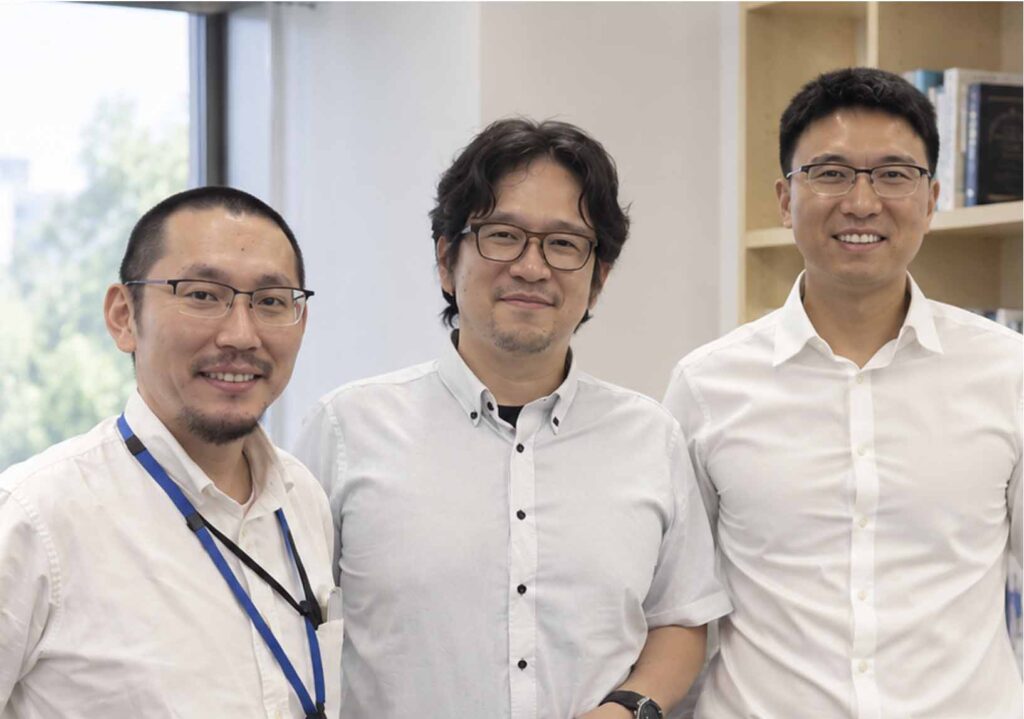
Associate Professor Takuma Matsubara and Professor Quan Yuan and I worked together as postdoctoral researchers at the Harvard School of Dental Medicine in the United States about 15 years ago. Since then, we have continued our individual research while maintaining contact, which has led to our current collaborative research. Many people may find it strange that we are conducting research on hair at a dental university. However, teeth and hair actually have very similar formation processes during the fetal period and are deeply related embryologically. In fact, there are many diseases in which symptoms appear in both teeth and hair. I am very pleased that we have been able to publish this international collaborative research on the theme of "hair" as one of the results of our long-standing collaboration. I would like to express my sincere gratitude to the many people who have given us advice and cooperation in this research. (Photo: Left: Associate Professor Takuma Matsubara, Center: Professor Shoichiro Furukabu, Right: Professor Quan Yuan)
[Terminology]
*1 METTL1: One of the enzymes that chemically modifies RNA. In particular, it is known as an enzyme that modifies transfer RNA (tRNA), which is involved in protein synthesis, with m⁷G. In this study, it was shown that it also acts on mRNA of genes involved in hair formation.
*2 Hair follicle: An organ within the skin that produces hair. It goes through a "hair cycle" consisting of a growth phase, a regression phase, and a resting phase, which allows hair to grow and be replaced.
*3 HOXC13: A gene involved in the formation of hair follicles and hair. It regulates the differentiation of hair-forming cells and the function of genes necessary for maintaining hair structure. In this study, it was found as a molecule that undergoes RNA modification by METTL1.
*4 m⁷G modification: A type of chemical modification in which a methyl group is added to guanosine, which makes up RNA. It is involved in regulating RNA stability and the process of protein synthesis from RNA.
*5 FOXN1 and DSG4: Molecules involved in hair formation. They function downstream of HOXC13, and DSG4 in particular is involved in the adhesion of hair-forming cells. This study showed that the expression of these molecules decreases when METTL1 is deficient.
*6 Transfer RNA (tRNA): RNA that plays a role in transporting necessary amino acids when cells make proteins. METTL1 was previously well known as an enzyme that modifies this tRNA with m⁷G.
*7 messenger RNA (mRNA): RNA that carries information for protein synthesis based on genetic information. This study showed that METTL1 modifies HOXC13 mRNA with m⁷G modification, maintaining its stability.
[Paper title]
Title: METTL1-mediated m7G modification regulates hair follicle cycle via the HOXC13/FOXN1/DSG4 axis
Author: Gan X, Li Q, Xiong Q, Huang D, Liu Z, Yin Q, Jiang S, Matsubara T, Kokabu S, Yan W, Yuan Q
Journal: PLoS Genetics
TWO: 10.1371 / journal.pgen.1012307
[Acknowledgment]
This joint research project was supported by the Ministry of Education, Culture, Sports, Science and Technology and the Japan Society for the Promotion of Science, Grants-in-Aid for Scientific Research, International Collaborative Research Acceleration Fund (Enhancement of International Collaborative Research (B)), 22KK0141.
[Contact]
Contact information for inquiries regarding this research
Kyushu Dental University, Division of Biochemistry
Professor Shoichiro Kokabu
E-mail: r14kokabu■fa.kyu-dent.ac.jp
*When sending, please replace ■ with @.
Contact information for inquiries regarding industry-academia collaboration at our university
Kyushu Dental University, Center for Comprehensive Research in Oral Medicine
E-mail: research■kyu-dent.ac.jp
*When sending, please replace ■ with @.
[About Kyushu Dental College, a Public University Corporation]
Kyushu Dental College is the only public dental school and dental college in Japan, and is a "comprehensive university of oral medicine" consisting of a department of dentistry and a department of oral health care. We believe that dentistry is medical care that supports daily life and happiness through "oral health." In the Faculty of Dentistry and the Graduate School of Dentistry, we are committed to nurturing dental professionals. In addition, since its opening in 1914, the attached hospital has continued to serve as a core hospital with dental expertise that is closely connected to the local community.
<Summary>
Name of school: Kyushu Dental College
Address: 2-6-1 Manazuru, Kokurakita-ku, Kitakyushu City, Fukuoka Prefecture
President Shuji Awano
Established in 1914
HP https://www.kyu-dent.ac.jp/